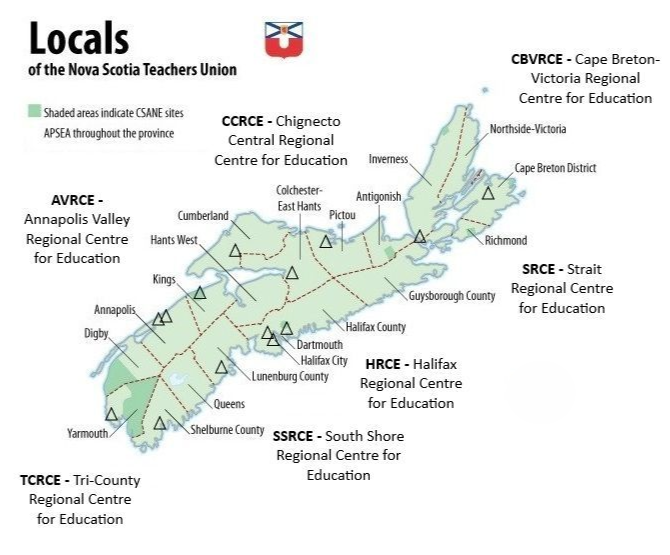
The Nova Scotia Teachers Union is divided into 22 locals. Click on the local name in the table below to access its associated website.

Annapolis

Dartmouth

Lunenburg County

Antigonish

Digby

Northside-Victoria

APSEA

Guysborough County

Pictou

Cape Breton District

Halifax City

Queens

Colchester-East Hants

Halifax County

Richmond

CSANE

Hants West

Shelburne County

Cumberland

Inverness

Yarmouth


Kings


NSTU Guidebook Excerpt

Section II – By-Laws of the Nova Scotia Teachers Union

Artcile IV – Local Governance

1. NSTU Locals

  1. Active Members may, with the consent of the Provincial Executive, form a Local.
  2. Every Active and Reserve Member shall belong to a Local and no Member shall belong to more than one Local.

2. Officers

  1. A Local shall elect a President, First Vice-President, and such other officers as the Local may determine.
  2. The elected Executive of the Local shall be the governing body thereof.

3. Governance

  1. A Local shall be a committee of the NSTU, and shall be under the control of the Council and its Executive, subject to the Teaching Profession Act, these 
    By-Laws, and NSTU Standing Orders.
  2. A Local shall not deal directly in matters of policy with the Provincial Government, government departments, or other provincial organizations.
  3. A Local shall determine the dates of its meetings and shall designate one (1) meeting each school year as its Annual General Meeting.
  4. A majority of Officers will constitute a quorum of the Local Executive.
  5. A Local shall have the right to submit resolutions to Council following the Resolution Procedures outlined in the Standing Orders

NSTU Operational Procedures Excerpt

Section I – Governance

12. NSTU Locals

A. STRUCTURE AND GOVERNANCE

Note: The Provincial Executive has the authority to establish NSTU Local governance and structure granted under Article IV of the By-Laws.

    1. Local Constitution Model
      1. The Provincial Executive adopted a Local Constitution Model which forms part of these Operational Procedures and is found in Appendix A. This Local Constitution Model outlines the structure and governance Locals must follow.
      2. The Provincial Executive reviews the Local Constitution Model on a regular basis and makes amendments as required.
    2. Local Operational Procedures
      1. A Local must adopt Local Operational Procedures as appropriate to complement the Local’s Constitution.
      2. Once Operational Procedures are adopted by a Local these procedures must be filed with NSTU Central Office.
B. ROLES AND RESPONSIBILITIES
    1. Roles and Responsibilities are categorized as follows:
      1. Local Executive – plans and implements policies and directives of the Provincial Executive.

      2. Local Executives – are encouraged to hold meetings early in each school year to inform new members and substitute teachers regarding: their rights and privileges; their duties and responsibilities; benefits of Active and Reserve Membership; and their obligation to supply their educational entity with accurate information for pay purposes.

      3. NSTU Representative – duties for NSTU representatives include, but are not limited to:
        1. The timely distribution and posting of NSTU information received through the provincial NSTU representative network.
        2. The timely distribution and posting of information received from the NSTU Local.
        3. Directing members’ requests to the appropriate Local or provincial support persons.
        4. Coordinating the collection of annual membership registry data in his/her educational site.
        5. Requesting time on the staff meeting agenda for NSTU updates.
        6. Calling other meetings as necessary.
        7. Assisting new members to become informed NSTU members.
        8. Identifying themselves to all members new to their educational site.
        9. Ensuring all members understand the NSTU representatives’ roles and duties.
        10. Conducting other functions as outlined in these Operational Procedures.

      4. General Membership – gathers and shares information.

    2. A member of the Local has the right to vote on all motions at Local General Meetings.